
How does Data Cloud work? Part II
Connect, Harmonize and Unify, Analyze and Act (CHUAA)

In my previous post I talked about what is Data Cloud and how it is different than Data Warehouse - here.
In this post, I’ll talk about how Data Cloud works. So, let’s get started.
I like this picture from Trailhead, that basically tells from high-level to more detailed level, how Data Cloud works:
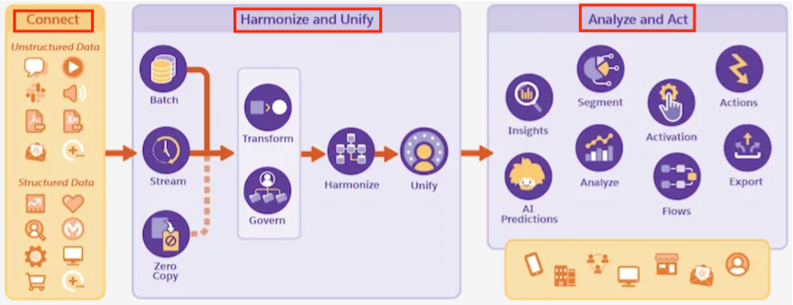
Data Cloud at high-level are mainly these 3 segments:
Connect
Harmonize and Unify
Analyze and Act
Connect: First, connect any type of data from all data sources, whether batch, streaming, or real-time, structured or unstructured data (Technically, here we will know about Data Stream and Data Lake Object (DLO))
Then prepare your data through transformation and governance features.
What are those sources:
Salesforce sources: Sales, Service, Commerce, and Marketing Cloud Engagement connectors
Third-party sources: Amazon S3, Google storage connectors
Zero-copy sources: Snowflake, Databricks, BigQuery
Ingestion API and Salesforce Interaction SDK
Web and Mobile connectors
MuleSoft connector
Harmonize and Unify: Harmonize your data to a standard data model and unify data with identity resolution rulesets. (Technically, here we will know about Data Model Object DMO, Unified Individual, governance tool (Data Space) to partition the data so you share certain space with certain group of users.)
Question I had here is why do we need to harmonize? Why not just connect data (step 1) and pass it to analyze (step 3)?
It is because different sources have different schemas. Now you can do point-to-point mapping ie. CRM —> ERP, ERP —> Billing. But wouldn’t be amazing if each system maps once to one model and all the other systems references from it, using one definition?
Thus, this idea of canonical reference model came in (Defined as DMO in Salesforce) that is standardized- defines the standard entities, attributes, and relationships - and gives a single, standard way to describe the business entity - like Customer.
Now look at the implication of this, it leads to identifying system of record too.
Analyze and Act: Analyze data using insight, segment audiences and create personalized experiences. Then Output data to multiples sources to act on it. (Technically, here we will know about Insights, Segment, Activation and Action)
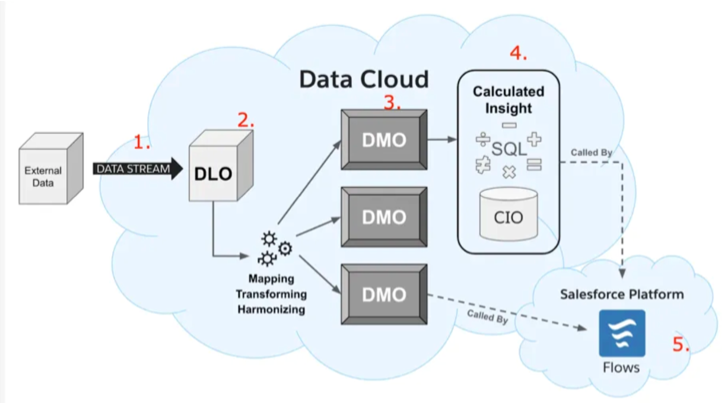
Most of the info I added here, I got from: this link.
Some of it I regurgitated and spun some of them in my own words.